
Budgeting Travel for Clinical Trial Monitoring Visits
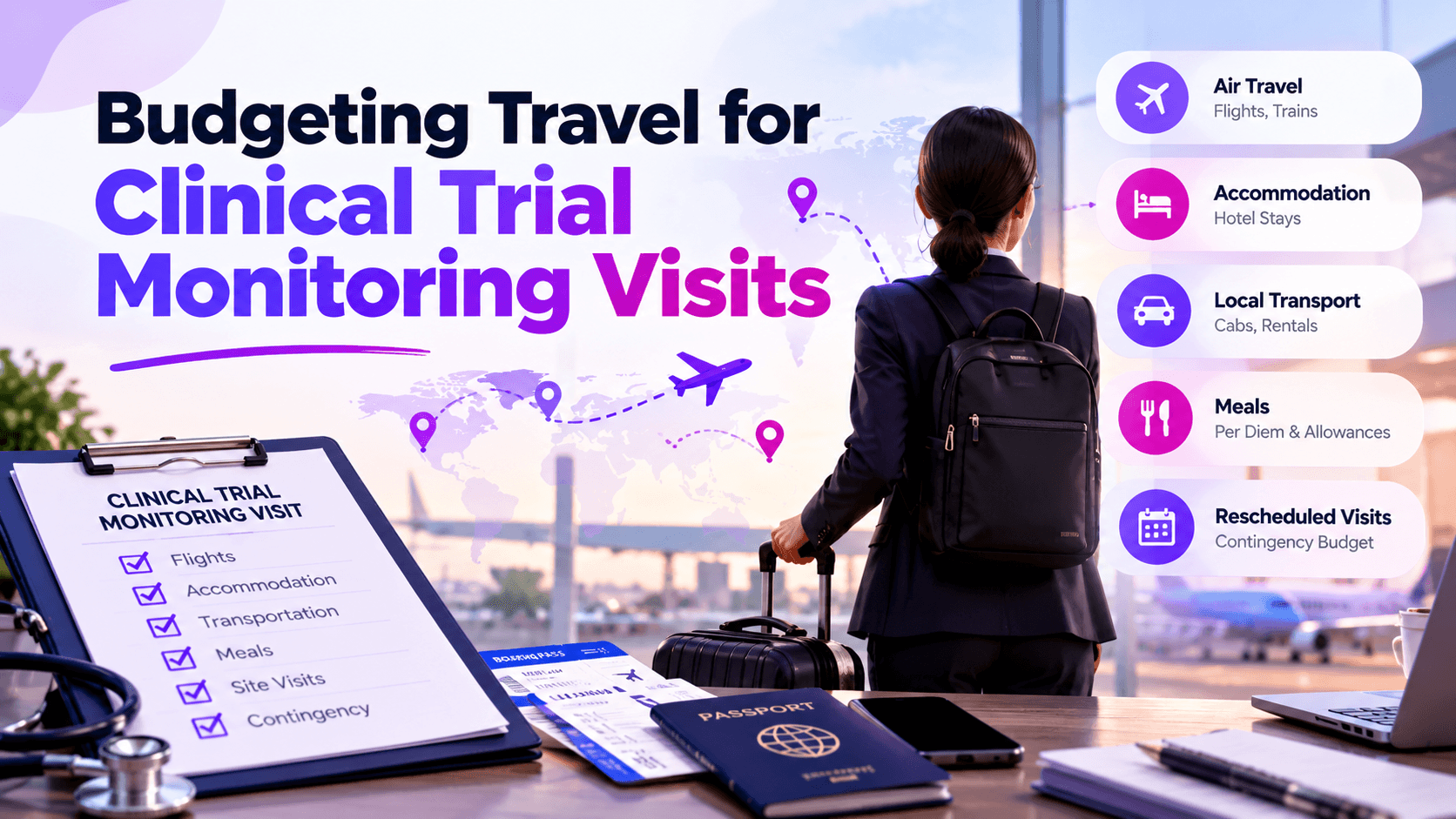
Monitoring visits in clinical trials involve a lot of traveling from city to city and even country to country. For the purposes of planning a study, the ability to accurately budget travel is a necessity for clinical operations managers, CRO finance teams, and trial project managers.
Airfares, train rides, accommodations, transportation, meals, and rescheduled visits can easily add up and drive up costs. With the help of expense management software, these expenses can be predicted, planned, tracked, and managed while making sure the travel related to the clinical trial is kept separate from general commercial traveling.
Get Ready with Site Locations
Site locations are the starting point for the development of the budget for monitoring visits. Some questions to consider are:
- How far the sites are from the monitor
- Whether it is domestic or international travel
- What kind of transport is available
- How much hotel stays cost in these locations
- What local transportation costs
- The anticipated number of monitoring visits
Expense tracking software for small business can help smaller CROs and research organizations to track site-level travel expenses without complete dependence on spreadsheets.
Expense management software, allows associating every expense with a particular study, site, employee, and visit. It helps to understand study-related expenses better.
Estimate Frequency of Visits

Travel budget should be defined based on expected monitoring schedule instead of just estimating annual travel budget.
For each site it can be calculated in such way:
Number of visits × average travel cost per visit = estimated site travel budget
For example, if a monitor is supposed to make six visits to a particular site and each visit costs around ₹25,000, the initial travel allocation will be ₹1,50,000.
Expense report automation allows comparing such estimates with actual expenses during the course of study. The finance team will know which sites have travel expenses higher than the initial budget.
Take Into Account Overnight Stay
Not all monitoring visits need accommodation. For one site the visit could take a whole day, while another one might be distant enough to make one or several nights in a hotel necessary.
When making the budget calculation estimate:
- Hotel nights per visit
- Average room rate
- Meals and`corresponding allowances
- Transportation
- Additional costs of early arrival or late departure
Automated expense management can assist in applying predefined travel policies for accommodation, meals, and transportation.
For large organizations, SME expense management rules can prove helpful in creating standardized travel controls for many projects.
Budget for Rescheduled Monitoring Visits
Rescheduled monitoring visits are another cost factor that is frequently overlooked.
Any number of events – flight cancellation, unavailability of the site, change of schedule for investigators, study-related delay – can require booking of new transport and/or hotel as well as paying additional costs associated with booking and canceling existing accommodations and transportation.
Instead of assuming that everything will go according to plan, it is better to include some contingency allocation into the travel budget of the study.
Expense management software can assist in identifying such costs by enabling the finance team to allocate categories for canceled, rescheduled and emergency travels.
In case of expense report automation, this will allow seeing whether additional costs are one-off or recurring events.
Keep Study Travel Separated from Commercial Travel
Clinical-trial travel cannot be combined with standard sales and commercial trips.
There might be different reasons why a pharmaceutical company’s employee travels:
- Clinical trial monitoring
- Investigator meetings
- Site initiation visits
- Site close-out visits
- Medical conferences
- Sales activities
- Customer meetings
It is very important to distinguish different purposes and budgets for different trips.
One of the expenses tracking spreadsheet problems is that expenses of different kinds might end up in one spreadsheet or the same expense category.
With automated expense management, companies can easily create different projects, studies, sites, and categories. This will help differentiate clinical-trial expenses from commercial ones.
Track Expenses at the Site Level
Study-wide travel budget gives you a big picture, but site level budget tracking is more useful for decision making.
For each site track:
Cost CategoryBudgetActualAir/Rail Travel₹80,000₹76,000Accommodation₹50,000₹54,000Local Transport₹20,000₹18,000Meals₹15,000₹16,000
The small business expense tracking software helps you to achieve this level of budgeting without a complicated financial system.
For larger CROs, expense management software can correlate each claim with the specific study and site, giving insight into the consumption of the travel budget for each project.
Don’t Manually Reconcile Expenses
Manually processed expenses can cause delays from when the monitor submits a claim to when the finance team has insight into the total cost of the study.
Expense report automation could optimize receipt gathering, submitting, approving, and reporting process.
In addition, automated expense management would help to comply with travel policies and detect missing documents and unusual expenses.
It would reduce problems with spreadsheet expense tracking, when formulas, duplications, old versions of the file, and inconsistency in the categories would complicate the budget monitoring.
How Expendesk Helps
Expendesk provides various features like receipt scanning with OCR technology, policy validation, approval process, duplicates elimination, audit trail, and live spending tracking. These features can be useful for businesses to centralize their expenses management and keep track of their expenditures.
For clinical operations teams, expense management software could provide a centralized view of monitoring-visit expenses. Teams can categorize claims by study, site, visit, employee, and type of expense.
Best expense management software helps you compare budgeted vs. real spending expense report automation reduces manual processing.
For smaller CROs, expense tracking software for small business can provide structured visibility without relying on multiple spreadsheets. SME expense management can also benefit from automated approvals and digital records.
Build a Budget That Can Adapt
Clinical trial travel rarely follows a perfectly predictable schedule. Site changes, rescheduled visits, additional monitoring requirements, and unexpected travel can affect the original budget.
The goal is therefore not just to create a fixed travel estimate. It is to continuously compare planned costs with actual expenses.
Using expense management software, automated expense management, and expense report automation gives clinical and finance teams better visibility throughout the study.
By avoiding the problems with spreadsheet expense tracking and using structured expense tracking software for small business or enterprise-level tools, organizations can keep study travel distinguishable from commercial travel and make every monitoring visit easier to budget and manage.