
Measuring the Full Cost of Residential Training for Medical Representatives
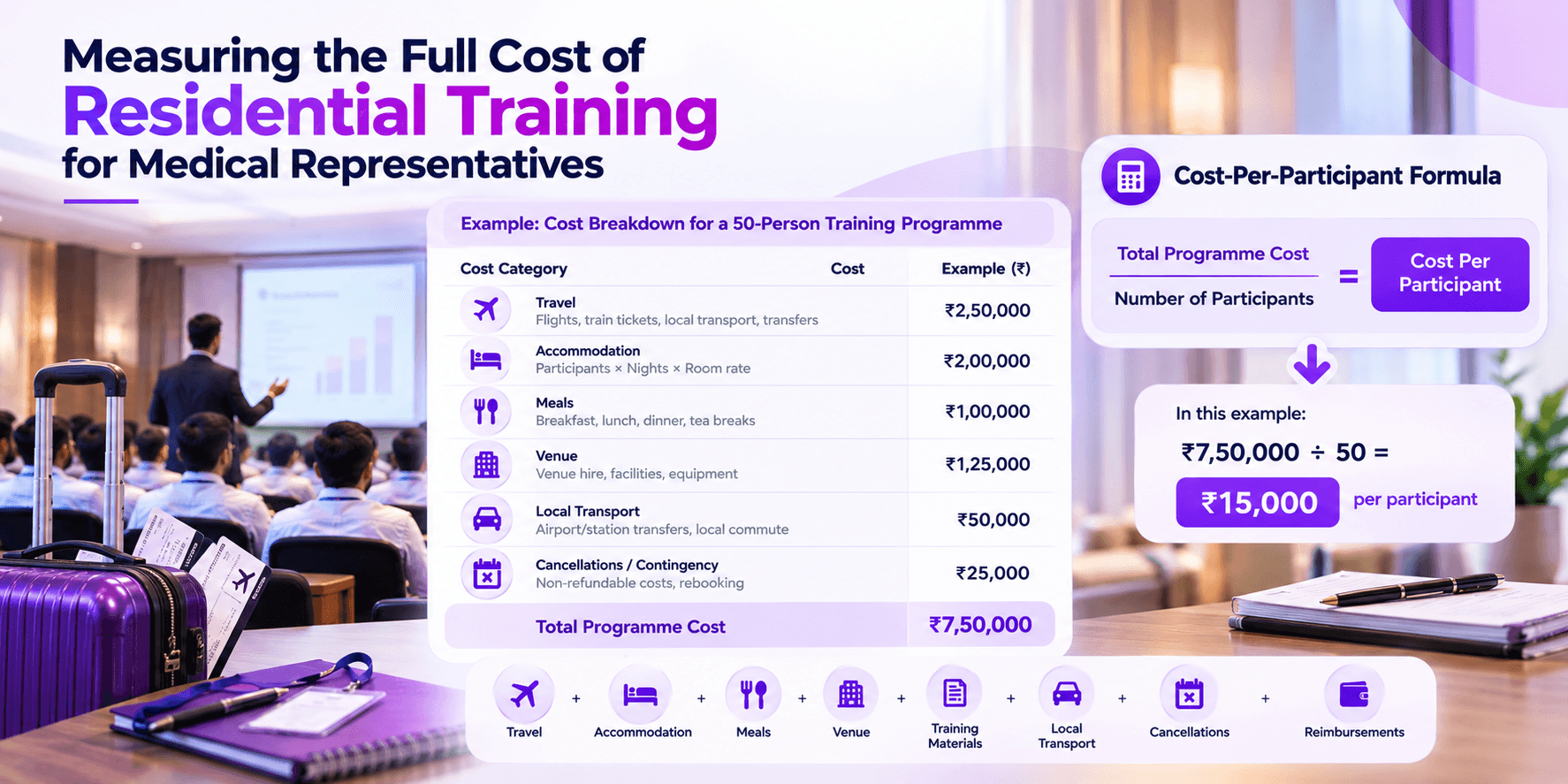
A two-day residential training programme seems fairly easy to organize: get a place, arrange accommodation and meals, and gather all medical representatives. However, the true cost per person is normally much bigger than the venue invoice.
A more accurate question for L&D departments of pharma companies is not “What did the training programme cost?” but “What did it cost to train each participant?”
Cost per participant needs to include such aspects as travel, accommodation, meals, venue costs, cancellations, and reimbursement of employees’ expenses. In case of residential training reimbursement of expenses incurred by medical representatives is likely to be one of them
Start Calculating Cost-per-Participant Formula

One possible formula is:
- Programme cost total ÷ number of participants = cost per participant
However, programme cost total should be calculated taking into account all necessary items, such as:
- Travel + Accommodation + Meals + Venue + Training Materials + Local Transport + Cancellations + Reimbursements
Let us take an example of a 50-person residential programme.
CostExampleTravel₹2,50,000Accommodation₹2,00,000Meals₹1,00,000Venue₹1,25,000Local transport₹50,000Cancellations/ contingency₹25,000Total₹7,50,000
Which will produce a cost per person for that programme of ₹15,000 per participant.
The above calculations show the way the cost of medical representative expense reimbursement contributes to the overall training budget.
Travel Is More Than the Ticket Price
Participants are likely to come from different territories, which makes travel one of the most volatile training expenses.
In that case, L&D team needs to calculate:
- Train or flight tickets
- Local transport
- Transfer from airport or train station
- Parking
- Meals en route
- Any extra nights
Where these costs will be reimbursed, there can be a separate operational issue related to employee reimbursement delays.
Having a centralized claim process of medical reps will make it easy to allocate the costs of every travel expense to the particular training programme, employee, and cost centre.
Accommodation and Meals Require Separate Assumptions
Accommodation will be required for every trainee at a residential training. Therefore, the budget must account for:
- Participants × Nights × Room Rate
Similarly, meals will be budgeted as:
- Participants × Meals per Day × Cost per Meal × Training Days
This separation will make it possible to update the budget easily if the number of trainees changes.
Also, medical representative expense reimbursement will become easier since centrally-paid costs can be separated from individual claims made by employees.
Don’t Forget About Cancellations
Cancellations may have a significant impact on the economics of residential training.
If a trainee who has booked hotel room or travel tickets cancels his participation in the programme, he may lead to:
- Non-refundable ticket costs
- Hotel cancellation fees
- Unused meals
- Venue adjustment fees
- Rebooking costs
These should be in a different category instead of being lumped in with the overall training expense costs.
Calculating this using reimbursement software for pharmaceutical companies will give L&D finance teams insight into how much money from the program budget gets lost due to changes in attendance.
Residential Training vs Regional Training
Residential training is not necessarily always more expensive depending on the circumstances and assumptions. Let’s take a look at two scenarios:
Cost FactorResidential ProgrammeRegional SessionsTravelHigher for distant participantsLowerAccommodationUsually requiredOften limitedVenueOne larger venueMultiple venuesMealsCentralizedLocation-specificCoordinationOne eventMultiple eventsCancellationsPotentially concentratedDistributed
While the regional model may save on traveling to far-away locations, having several venues to handle will add costs to the budget.
And so the proper way of measuring is cost per attendee, not just the total invoice.
When Does Reimbursement Become Important?
Residential training programs often lead to the submission of expense claims by employees for travel and miscellaneous expenses. Unless there is a proper procedure in place, employee reimbursement delays will lead to more paperwork being generated for employees and finance departments.
An efficient medical rep claim process needs to be able to specify:
- The types of expenses employees can submit claims for
- Limits that apply to such claims
- Necessary receipts
- The due date submitting expense claims
- Approvals procedures
- Timescales for expense reimbursements
Submitting mobile expense claims for field teams means that employees will be able to do that when they are traveling, rather than having to wait until they return back to their territories.
That approach can provide faster reimbursement for field staff without increasing the amount of manual paperwork.
Collect Digital Receipts to See the Full Cost of the Program
The use of Digital receipt capture for pharma will allow for a better understanding of the cost of the training program. Receipts will be collected at the time of purchase instead of having to gather them after days or even weeks.
In terms of expense reporting and tracking, it makes things easier for businesses who deal with medical representative expense reimbursement.
It may also be easier for the business to tie individual claims to the right training event and cost centre using reimbursement software for pharmaceutical companies.
Ways Expendesk Can Help Manage Training Expenses
Expendesk offers digital receipt scanning using OCR, policy compliance checking, automated approval processes, duplicate checking, audit trails, and spend visibility in real time.
For L&D teams, these features could be used to streamline medical representative expense reimbursement.
With expense claims for mobile use by field teams representatives can report their expenses digitally. Pharma receipt scanning is used for support documents, and automated processes can minimize time delays in reimbursement of employees.
Also, a standardized process of reimbursement of medical representatives gives better insight to the finance department about the cost of each training program.
Calculate Before You Book
The cost of residential training is often hidden in venue quotes. In fact, it lies in travel, hotel rooms, food, claims, cancellations, and administration.
Through calculation of cost per participant and comparison of residential training programs to regional ones, L&D departments of pharma companies will have clear training budgets.
With reimbursement software for pharmaceutical companies, mobile expense claims for field teams, faster reimbursement for field staff, and digital receipt capture for pharma, the reimbursement side of training can become easier to manage and measure.