
Employee Meals vs Healthcare Professional Hospitality: How to Define Pharma Expense Categories
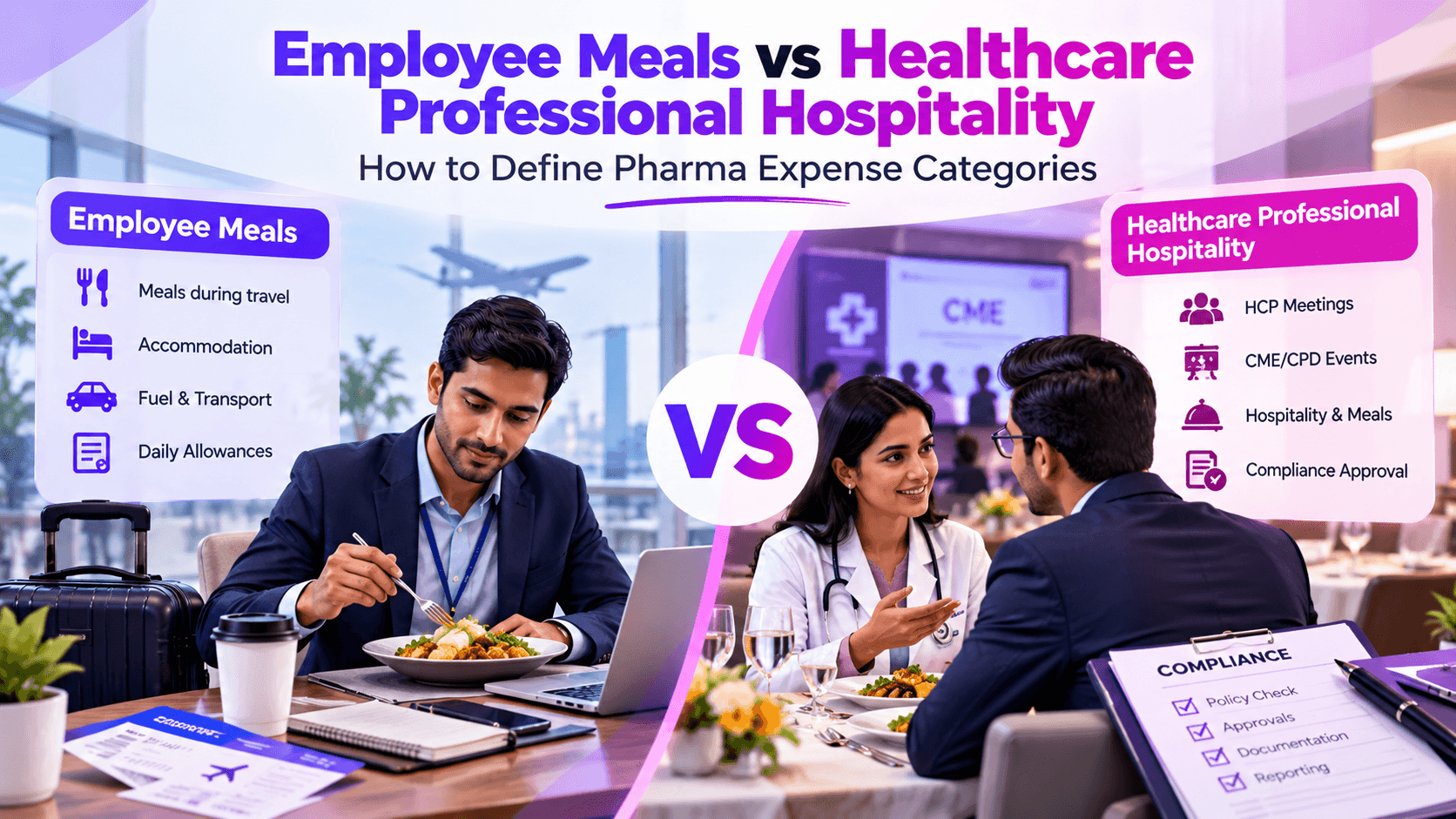
A pharmaceutical company has to process thousands of expenses relating to trips, meals, accommodation, field visits, meetings and other interactions with healthcare professionals (HCPs). However, if a company treats all expenses associated with food or hospitality in the same category, it creates challenges for compliance and reporting.
For businesses that employ many reps, pharma sales force automation, medical rep travel expenses, and pharmaceutical field force expenses should be handled in separate categories. A field force expense management software module would be able to handle MR expense reporting and expense tracking for pharma companies better.
Importance of Separate Expense Categories
An employee’s meal during a sanctioned business trip is different from hospitality offered to an HCP. These two types of expenses have different requirements regarding policy, documentation, approval procedure, and compliance issues.
Therefore, expense management for pharmaceutical companies should establish different categories for employee meals and HCP hospitality. A proper expense tracking for pharma companies allows finance teams to understand the nature and participants of each transaction.
For organizations utilizing pharma sales force automation, the process of expense management should complement the field activities rather than lumping all expenses into one.
Employee Meals and Travel Expenses for Medical Reps
Employee meals are usually a part of a business trip or employee subsistence. E.g., an MR travelling from one territory to another will be spending on meals among other medical rep travel expenses.
These medical rep travel expenses include the following:
- Meal while travelling officially
- Hotel accommodation
- Fuel
- Parking
- Transportation
- Daily allowances approved
Clear guidelines make MR expense reporting easier. A field force expense management software solution helps collect the receipts, date of the receipt, place, amount, and the purpose of the medical rep travel expenses.
This will help with expense management for pharmaceutical companies and provide more visibility to pharmaceutical field force expenses.
Healthcare Professional Hospitality Is DNot The Same
HCP-related hospitality transactions need special attention due to the involvement of an external healthcare professional.
In India, the Uniform Code for Pharmaceutical Marketing Practices (UCPMP) 2024 covers hospitality offered by pharmaceutical companies to the healthcare professionals. The Code says that neither a company nor its representatives must offer the hospitality, including hotel accommodation, fancy cuisine, resort stay, to HCPs or their family members, except when the HCP is going to become the speaker of a CME or CPD event.
This means that expense management for pharmaceutical companies cannot treat the HCP hospitality in the same way as ordinary employee meals.
Thus, a quality field force expense management software solution would allow finance and compliance departments to split these two types of expenses. It would enhance MR expense reporting and expense tracking for pharma companies.
Which Information Should Be Captured?

For common employee meals and medical rep travel expenses, companies might capture:
- Employee name
- Date and location
- Purpose
- Amount
- Receipt
- Travel reference
- Limit according to the relevant policy
For expenses associated with HCPs, companies might need to gather more information, including HCP’s professional information, the event purpose, participants, organizers, approval and evidence.
That is why the above distinction is critical to expense management for pharmaceutical companies as a receipt itself might not be enough.
In case of pharmaceutical field force expenses, expense tracking for pharma companies should therefore capture both the financial aspect and the business context.
The Importance of MR Expense Reporting
There are a number of claims filed by employees in one day. In order to make proper expense management for pharmaceutical companies, it’s important to have some MR expense reporting in place.
For instance, there could be MR who submits a claim worth of ₹1,000. This receipt doesn’t show the reviewer whether it’s a claim regarding the MR’s own meal while on the trip or an expense connected to HCP.
For that reason, MR expense reporting is supposed to collect certain data in advance.
As a result, using field force expense management software, it is possible to create separate categories and require more data for sensitive expenses. It is going to improve expense management for pharmaceutical companies and reduce ambiguity in pharmaceutical field force expenses.
How to Connect Pharma Sales Force Automation With Expense Controls
Pharma sales force automation could be helpful when it comes to managing territories, scheduling, field activities and sales calls. But pharma sales force automation shouldn’t substitute the process of financial compliance.
Combining pharma sales force automation with expense tracking for pharma companies will give more context to pharmaceutical field force expenses.
For instance, a field visit tracked with the aid of pharma sales force automation will give operational context for the related medical rep travel expenses. Then the finance expense management platform can track the financial transaction, receipt, and approval.
This combination will structure the expense management for pharmaceutical companies.
Create Separate Approval Workflows
Not all categories must use similar approval workflows.
Routine meals consumed by employees will follow a standard manager and finance approval process. However, HCP- related transactions will require a compliance team’s additional approval.
A field force expense management software platform can offer workflows such as:
Employee meal → Manager approval → Finance
HCP-related expense → Manager review → Compliance review → Finance
It will make MR expense reporting easy while giving a compliance team an opportunity to focus on sensitive transactions.
In addition, this will help in expense tracking for pharma companies by highlighting which expenses will require additional reviews.
How Expendesk Supports Expense Management
Expendesk provides the functionality for capturing receipts through the use of OCR technology, automated policy validation, approvals, duplicate detections, audits, and spend insights.
These functionalities can be used to facilitate expense management for pharmaceutical companies through consolidation of receipts, claims, approvals, and policy checks.
In case pharmaceutical companies have high pharmaceutical field force expenses,they can use field force expense management software in order to establish uniformity in category and approval process.
Digitized processes will also be beneficial when it comes to MR expense reporting, and expense tracking for pharma companies will allow finance teams to see all expenses consolidated.
In conjunction with pharma sales force automation, the process will help organisations relate field force activities to corresponding expenses without treating all transactions in the same way.
Build a Clear Pharma Expense Taxonomy
In order to create a practical policy of expense management for pharmaceutical companies one needs to include categories such as:
- Employee subsistence
- Medical representative travel
- Internal business meals
- HCP-related expenses
- CME/CPD-related expenses
- Accommodation
- Fuel and transportation
Clear categories will enhance expense tracking for pharma companies and allow analyzing pharmaceutical field force expenses easier to analyze.
They will also help differentiate medical rep travel expenses easier to distinguish from HCP-related transactions.
There needs to be a difference between employee meals and HCP hospitality expenses. Good management of expenses for pharmaceuticals requires proper classification, proper documentation, and risk-based review of the expenses.
With the help of a well-managed MR expense reporting system, specified field force expense management system, and improved expense management for pharma companies, organizations can gain visibility into the travel expenses of medical reps and pharmaceutical field force.
Pharma sales force automation can offer valuable operational context, while expense management for pharmaceutical companies offers financial context.
In India, the compliance team needs to check the HCP-related expenses based on the existing UCPMP guidelines and the policies of the organization. Regulatory guidelines may vary based on different jurisdictions, so pharmaceutical companies operating in various countries need to apply their guidelines.