
Travel & Expense (T&E) Management Solution: Complete Guide for Growing Businesses & MNCs
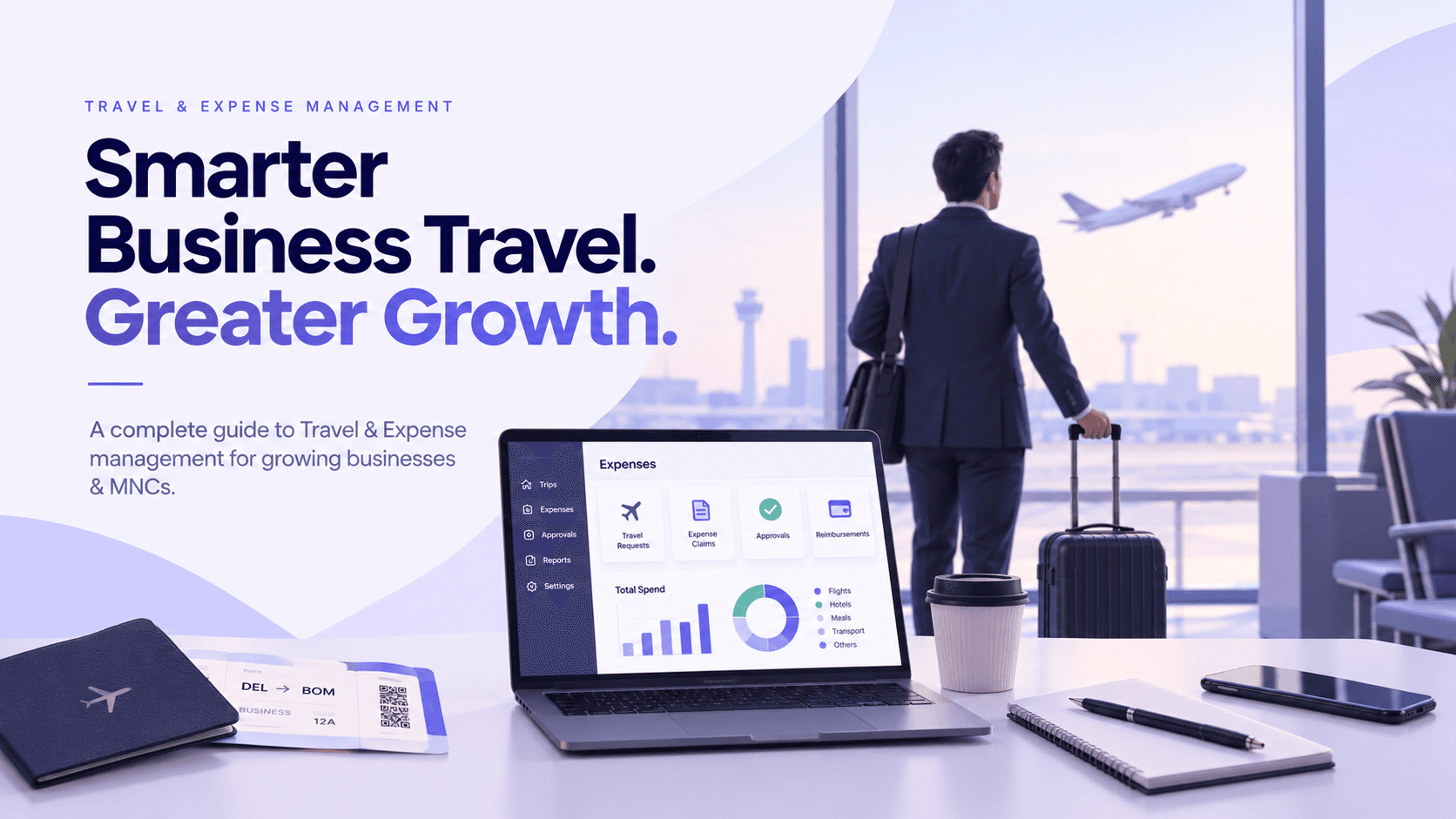
Business travel is required for customer interaction, sales, meetings, conference attendance and business expansion. Managing the expenses that come along with the frequent business travels can be a challenge for a growing business.
Here comes travel expense management software to save the day. T&E solution can help manage the entire expense lifecycle, starting from travel requests and advances all the way to claim submission, approvals, reimbursements and reporting.
What Is Corporate Travel & Expense Management?
Corporate travel and expense management is about planning, controlling, approving and reimbursement of business travel expenses.
Common business travel expense management workflow is as follows:
- Employee submits a travel request.
- It gets approved by the manager or department head
- Business travel is arranged in accordance with company policy
- An advance can be provided
- Employee incurs business travel expenses
- Receipts and claims are submitted
- Claim gets reviewed and approved
- Expenses are reimbursed
- Expense are accounted for
Managing this workflow manually becomes difficult when companies have 50 to 1,000 employees and/or MNC branch offices.
Why Is T&E Management Needed?
- Better Control Over Spending
With the expenses spread out between spreadsheets, emails and accounting software, financial teams may fail to have an overview of the overall travel spending. By providing visibility into spending by employee, department, project, location and expense category, a single platform will allow doing just that.
- Improved Compliance
By creating a clear travel and expense policy, one can have restrictions for airfares, hotel accommodation, meals, mileage and any other expenses. With automated policy enforcement, it will be possible to highlight violations.
- Faster Reimbursements
Manual checking and email-based approval process might lead to delays in employee reimbursements. Digital submission and automated workflows could reduce the time needed for processing the claim and help employees get a better visibility into the status of their claims.
- Fewer Mistakes
Manual data entry can cause errors in amounts, duplicates and missing receipts. Automation could help standardize the process of expense submission and verification.
- Compliance Improvement
One needs the proper documentation for accountancy, audit purposes and taxes that might apply. Digital documentation could help with the management of invoices and documents including GST-related ones.
The Complete Corporate T&E Lifecycle

A good corporate travel and expense management system should encompass the whole process.
- Travel Requests
Employees should have the ability to make travel requests containing details such as the destination, dates, purpose, estimated expense amount, client/project and the mode of transport.
It provides managers with the knowledge of the spending to be incurred prior to the journey.
- Multi-Level Approvals
Some expenses require higher approval levels than others. Domestic travel might require manager approval while international trips might need department head or finance approval.
- Travel Advances
At times, employees may require some money to pay for the accommodation, transport or any other expenses. A corporate travel expense management system should document the advance and match it with the final claim made by the employee.
- Submitting Expenses Claims
Following the trip, employees should be able to submit their expenses electronically. Some of the common expenses are airfare, accommodation, meals, transport, parking, toll charges, miles driven, and per diem
- Verification and Approval
Finance teams may be able to check claims against corporate policy. This includes identifying missing receipts, duplicate entries, expenses over limits and claims made after the permitted deadline.
- Reimbursement
Approved claims are processed without the need for extended back-and-forth via emails. Employees can keep track of the progress of their claims.
- Reporting
Finance teams can get insights into travel expenses per employee, per department, per project, per category and per location. Such insights are useful for corporate management in managing trends and controlling future budgets.
What Should a Travel & Expense Policy Include?
A clear travel and expense policy makes it easy for employees to understand what they can claim and avoid unnecessary disputes.
Such a policy should typically include information on:
- Who can submit claims and what kinds of expenses qualify
- Classes of fight and train travel
- Limits on hotel and accommodation expenses
- Meal and per-diem expenses
- Rates of mileage reimbursement
- Travel advance process
- Receipts and documents required
- Approval hierarchy
- Claims deadline
- Exceptions and policy violation procedure
Having a standard corporate policy ensures consistency throughout departments and locations.
Travel Expense Management Software Selection Criteria
There are two major factors to consider while selecting travel expense management software : features and scalability.
In case of the finance team of an organization, the following criteria should be considered:
- Automated approval workflows: Support for manager, department and finance approvals.
- Travel advances: issuance, tracking and reconciliation of employee advances
- Mileage and per-diem management: configurable calculations according to company policy
- Digital receipt management: ability to submit and store receipts and supporting documents
- Policy enforcement: automatic recognition of out-of-policy expenses
- GST-ready documentation: ability to efficiently capture and organize required invoice and tax information for Indian businesses.
- Reporting and analytics: detailed insights on travel expenses and reimbursements.
- Integrations capability: connection to accounting, payroll and other finance systems.
- Scalability: possibility to support multiple departments, branches, approval hierarchy and transaction volumes.
Advantages of Using Automation for T&E of Growing Companies
Some organizations that have a small number of employees and a relatively low frequency of travel can manage travel expenses manually using Excel sheets. As the company grows, manual processes become inefficient.
Automation can provide the following benefits for organizations:
- Reduce repetitive finance tasks
- Increases spending visibility
- Accelerates reimbursements
- Enforces company policies
- Avoid duplicate and erroneous claims
- Improves documentation
- Streamlines audits
- Improves employee experience
- Scales finance operations effectively
The aim is not only to expedite the claims but to establish a systemized and transparent expense ecosystem.
Ways Expendesk Can Help
The solution may be useful for organizations that want to simplify their expense management processes. The features related to mileage, per-diem, advances and travel claims may be useful for establishing connections between various stages of the T&E cycle.
By abandoning spreadsheets and emails for processing claims, finance departments may develop an organized way to handle employee expenses and get a greater transparency into business spending.
Business travel needs to facilitate business growth and not cause any bureaucratic trouble. An efficient travel expense management process will connect employees, managers, and finance departments in a single workflow.
For growing enterprises and MNCs, the travel expense management software will allow transforming T&E into an organized and data-driven process.
A proper solution will enable a business to answer three important questions: Where are we spending? Is the spending aligned with the policy? And is our process scalable with the company’s growth?
Having the answers at hand will make corporate travel easier to manage and scale.