
How Pharma Companies Should Design TA/DA & Daily Allowance Structures for Medical Representatives
It goes without saying that any medical representative has to make a number of trips to see various doctors. A typical working day as a field representative involves multiple visits, travel to a considerable distance, expenditure of the fuel, lunch, dinner and even overnight stays. The HR and finance departments of pharma companies should develop an appropriate TA DA allowance structure which will be good for employees and at the same time controllable for the business.
The following are the characteristics of a properly designed TA DA allowance policy which should take into account HQ, ex-HQ and outstation travel as well as fuel, meal, accommodation and reimbursement policies.
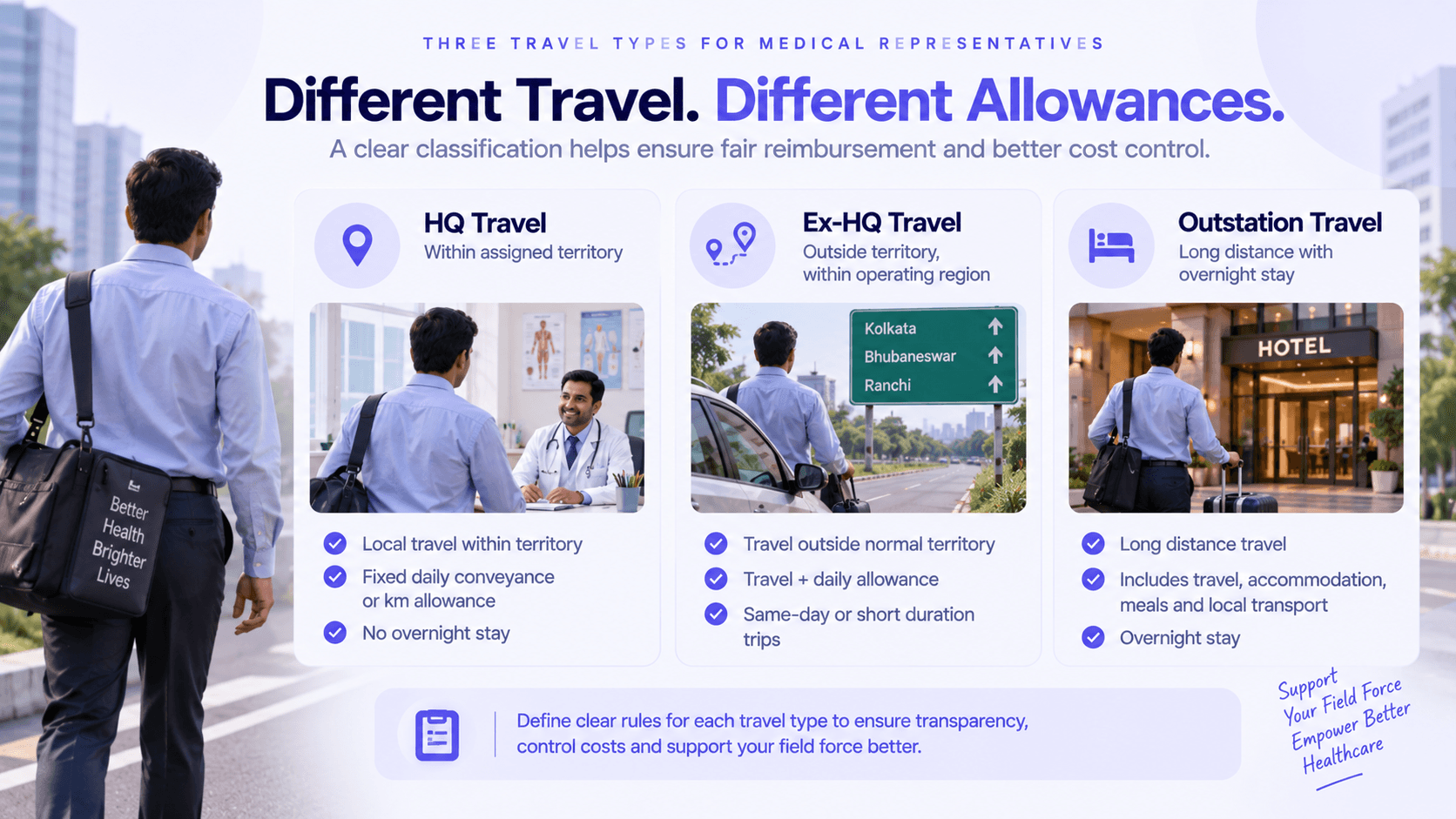
Three Travel Types of Travel
The most convenient approach in designing a TA DA allowance policy consists in dividing the travel into three types.
The first one is HQ travel which concerns all types of travel inside the medical representative’s territory. There are two possible approaches: the fixed daily conveyance amount and kilometrage allowance.
Ex-HQ travel is when the medical representative travels outside the normal HQ territory but still within the entire operating region. The TA DA allowance can then be made up of travel and daily allowance.
Outstation travel usually means longer distance travel and overnight stay in a hotel. TA DA allowance can therefore include travel costs, accommodation, meals, and local transportation.
Clearly starting when any of the two kinds of travel occurs would help the employees know when any allowance falls under which.
What is Daily Allowance?

Daily allowance for medical representatives should be reasonable meals and incidentals when the medical representative goes outstation and works.
The amount is universally prescribed. The pharma companies should formulate the allowance depending on their field force needs, travel pattern, cost of cities they operate in, budget and other considerations.
The rates can vary depending on whether the medical representative travels HQ, ex-HQ, tier ⅔ cities and big metro cites, This should not be treated as statutory allowance.
It should also specify whether the daily allowance for medical representatives includes the total meal and certain meals should be claimed separately to avoid duplicate claims.
Separate Fuel From Daily Allowances
Fuel cost can be a sizable recurring cost component for medical representatives who need to take their personal vehicle for visiting territories.
The company may have fuel reimbursement either based on fuel bills or an approved per-kilometre cost. In the case of per kilometre, the calculation would be:
- Eligible kilometres × approved rate per kilometre = fuel/conveyance claim
If the company gives a fixed petrol allowance for employees, it must specify whether the above allowance replaces the kilometre-based fuel reimbursement or works in conjunction with the latter.
In addition, it must be made clear what are the eligible travel journeys. Company territory travel and personal commuting are not to be assumed as one and the same cost components.
Consider the Tax Treatment
Tax treatment of travel and daily allowance costs depend on the type of payment and applicable rules.
Based on India’s Rule 2BB and Section 10(14), some allowances given for official travel and ordinary daily expenditures while away from the employee’s normal place of duty may qualify for exemption based on applicable conditions and qualifying expenditures.
Thus, it is wrong for a company to treat all TA DA allowance as tax-free only because the name implies.
The finance and payroll team needs to analyze the particular allowance, document, expenses, and applicable taxation scheme before deciding on its taxability.
Simplify the Reimbursement Process
Complex reimbursement forms will cause additional difficulties both for medical representatives and for the finance department.
Good reimbursement form needs to include the following information:
- Employee details
- Territory details
- Travel date
- HQ/ ex-HQ/outstation classification
- Start point and end point of the journey
- Reason for travelling
- Mode of transportation
- Number of kilometers travelled
- Accommodation details
- Receipts
- Manager’s approval
In case of fuel reimbursement, reimbursement form needs to include the information needed according to the selected method of reimbursement.
Online submission of the reimbursement form will help eliminate data entry errors and facilitate claims approvals.
Automate Medical Representative Claims
Large pharma field forces generate hundreds or even thousands of claims per month. Monthly checking each TA DA allowance, fuel reimbursement, and reimbursement form takes much of the finance team’s time.
Expendesk offers automated receipt uploading via OCR, automated validation of policies, claims approval workflow, duplicates identification,auditing tools, and real-time spend visibility.
This solution helps to create distinct rules for HQ, ex-HQ, and outstation claims, as well as to route expenses to relevant approval workflows.
Medical representatives can attach the necessary documents automatically, while finance teams can get insight into field force spending.
Create an Effective Field Force Policy
A good TA DA allowance policy must be easy for a medical representative to understand and detailed enough for finance to audit it.
The first step is to define the type of travel that is considered HQ, ex-HQ, and outstation. Then, create reasonable daily allowance for medical representatives, define transparent fuel reimbursement policy, determine whether a petrol allowance for employees exists and what a reimbursement form should look like.
Review actual expense claims periodically. If employees continue to exceed the accommodation, fuel, or daily allowances, the company can assess whether this is due to old rates, exceptional travel needs, or poor controls.
An organized TA DA allowance scheme helps medical representatives get predictable expense reimbursement while enabling pharmaceutical HR, sales, and finance departments to control the costs of their field force.